The Game
Backgammon — a history, and how to play.
Heir to five thousand years of race games, and recognisably itself since the taverns of Rome and the courts of Persia. What follows is the story of the game — and then, below, everything you need to play it properly.
Antiquity
A family five thousand years old
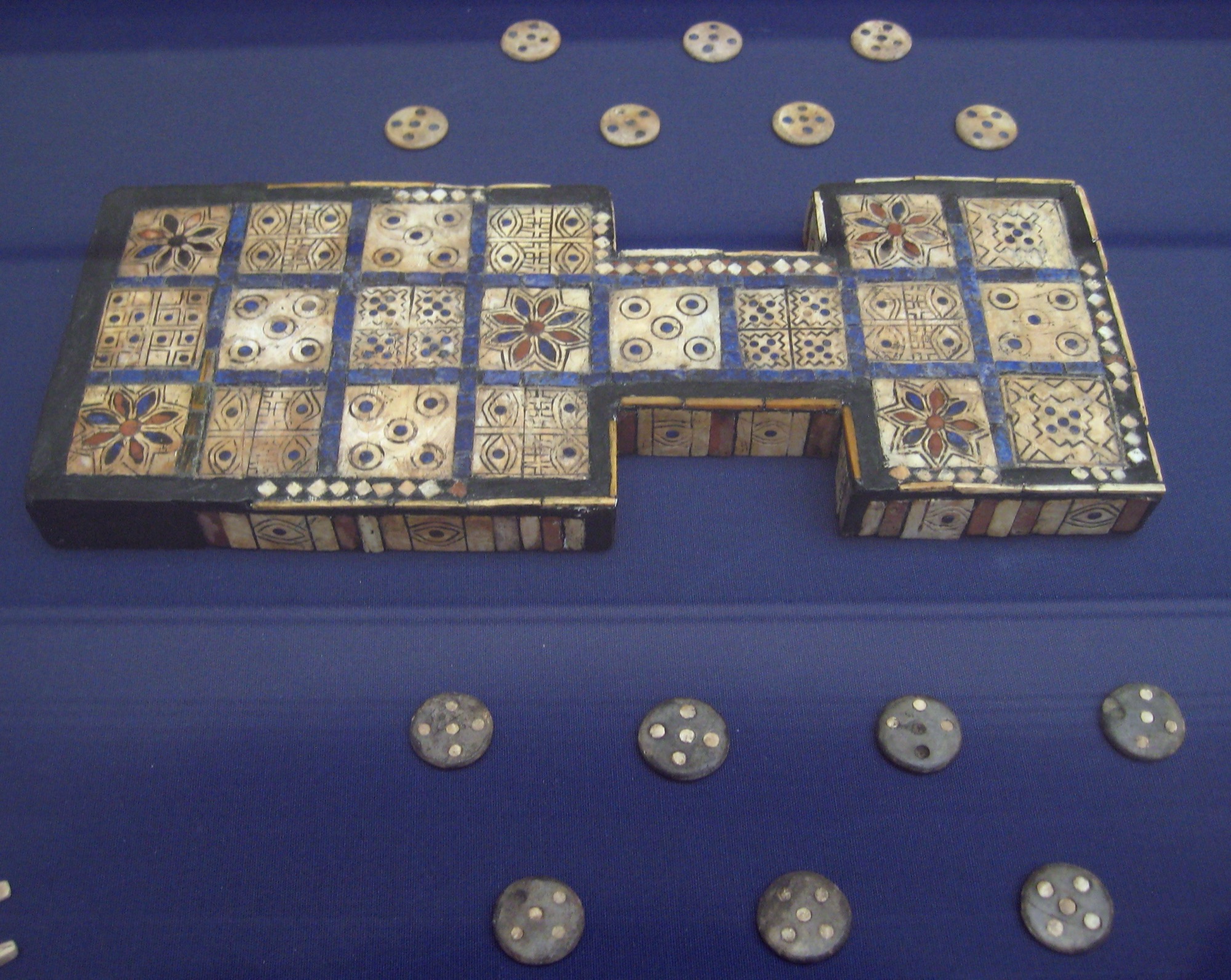
The oldest playable board game in the world was found in the royal tombs of Ur, in what is now southern Iraq — a race game of twenty squares, inlaid in shell and lapis, buried around 2600 BC. The British Museum keeps the board; its rules survive because a Babylonian scribe wrote them onto a clay tablet in 177 BC, deciphered in our own time by the curator Irving Finkel.
Backgammon is not this game — but it is family. The same dice, the same race, the same argument with fate. Boards of the kind travelled from Iraq to Crete across three thousand years, before one of them settled into a shape any modern player would recognise.
Rome
Twelve lines, three dice, one emperor
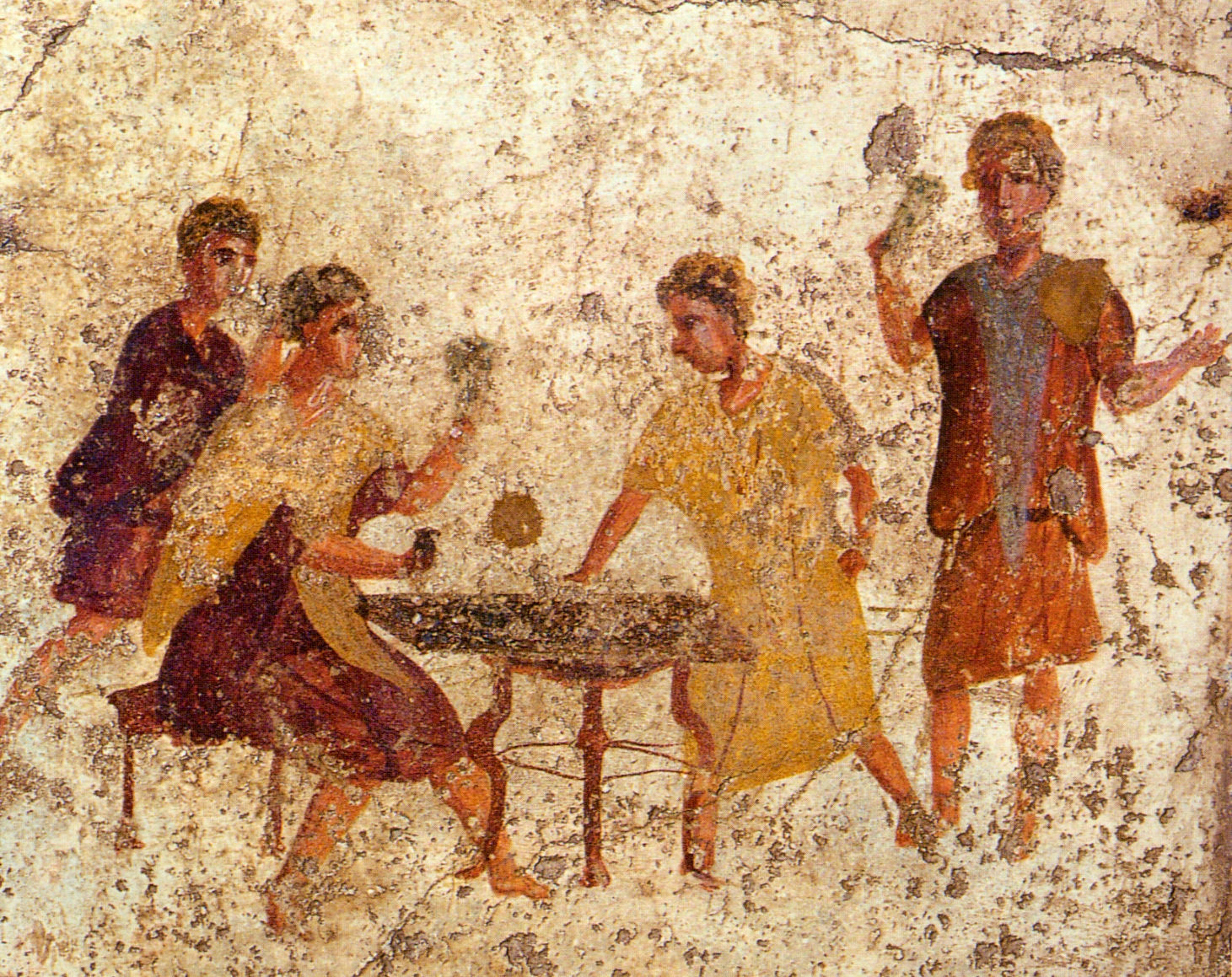
The Romans played ludus duodecim scriptorum — the game of twelve markings — and later tabula, which dropped a row and left twenty-four points that a modern player could sit down at without instruction. The emperor Claudius was so devoted to the dice that he had a board fitted to his carriage, so the road would not disturb the game, and published a book on the art. The book is lost. The habit was not.
Four centuries later the emperor Zeno rolled a two, a five and a six so ruinous that a court poet preserved the entire position in verse — the first recorded bad beat in the history of the game.
Persia
Nard, and the wager of two empires
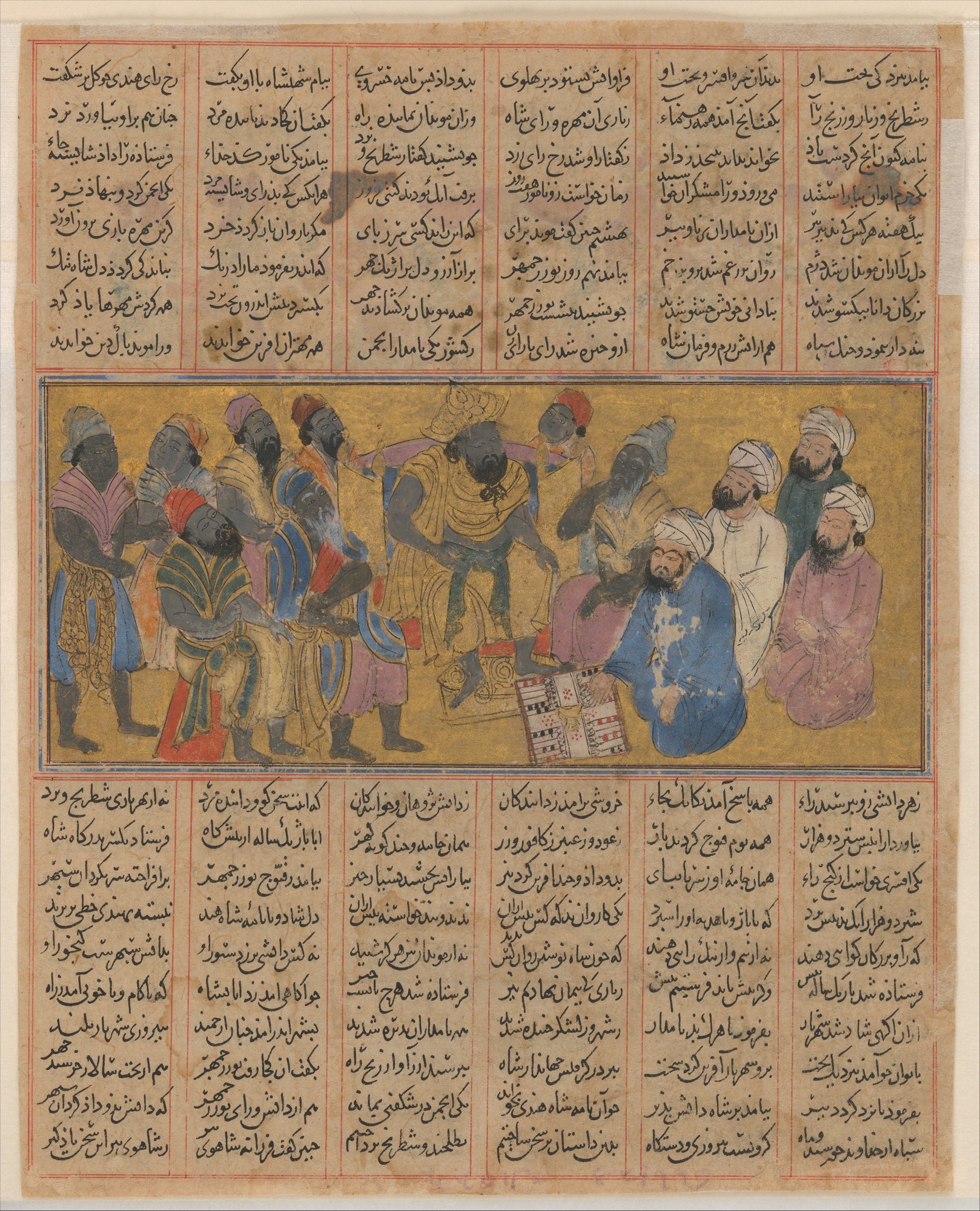
Persia tells the story best. An Indian king sends the game of chess to the court of Khosrow I as a riddle — solve how it is played, or pay tribute. The sage Bozorgmehr solves it in a day, and answers with a game of his own devising, nard, which India cannot unravel. The tale is legend, set down in a Sasanian text of the sixth century; the game was real, and so was its meaning — the Persians read the board as a small cosmology, its checkers the days, its dice the hand of fate.
The name honoured Ardashir, founder of the dynasty. Centuries wore it down to nard; in Iran the game is takhteh to this day.
Medieval Europe
Tables — the game of every court
In Europe it was simply tables. A complete eleventh-century set — thirty bone checkers and the board to play them on — was dug out of the ground at Gloucester Castle. Chaucer’s gentlefolk “dauncen, and pleyen at ches and tables.” Wintering in Sicily on the way to the Third Crusade, Richard the Lionheart and Philip of France had to cap their knights’ play at twenty shillings a day. The church legislated against the dice; Louis IX banned their manufacture in France outright. None of it worked.
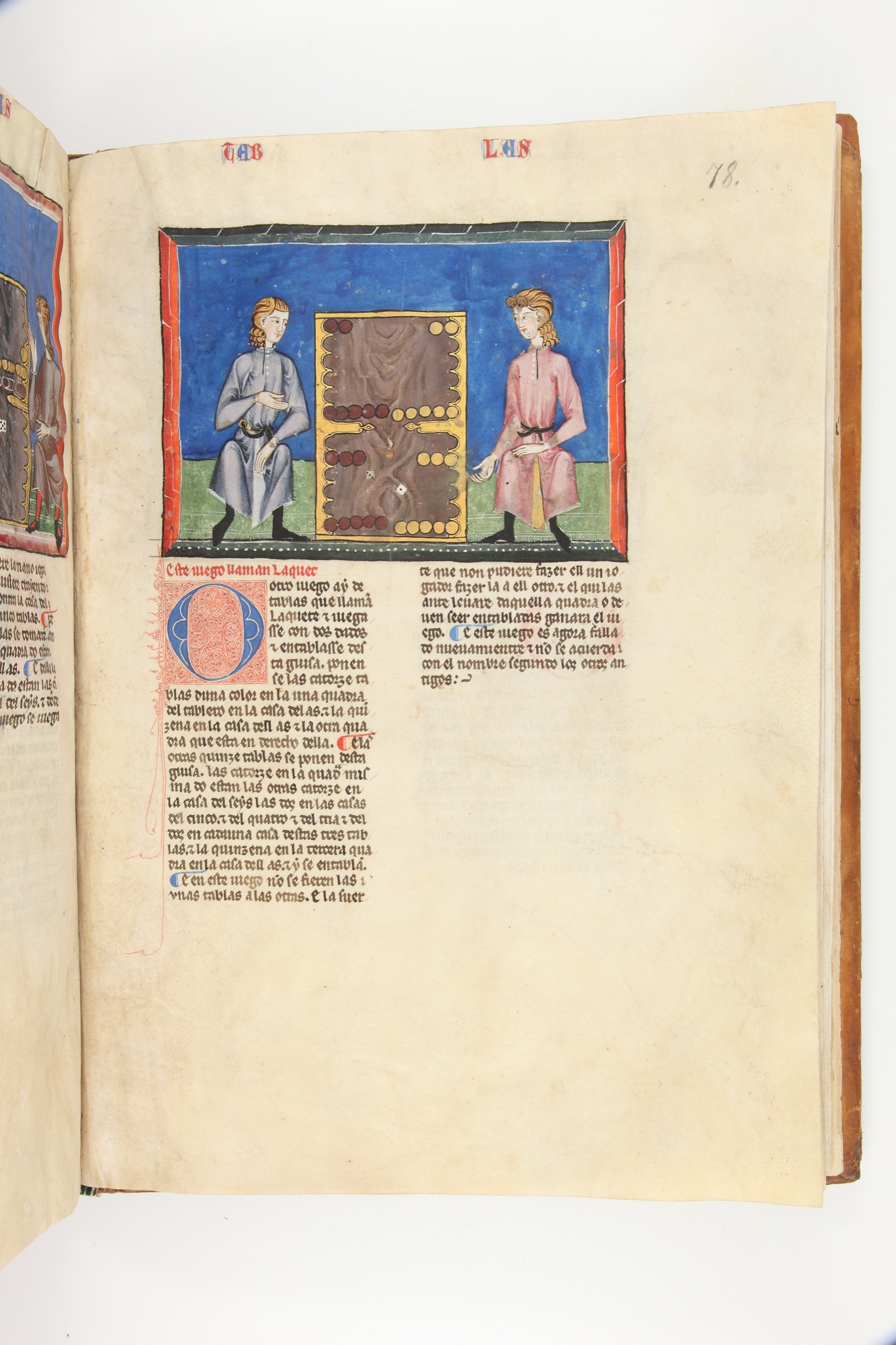
In 1283 Alfonso X of Castile had the whole family written down in his Libro de los juegos — fifteen tables games, one of which, todas tablas, opens with exactly the arrangement set out in the rules below.
England
The game gets its name
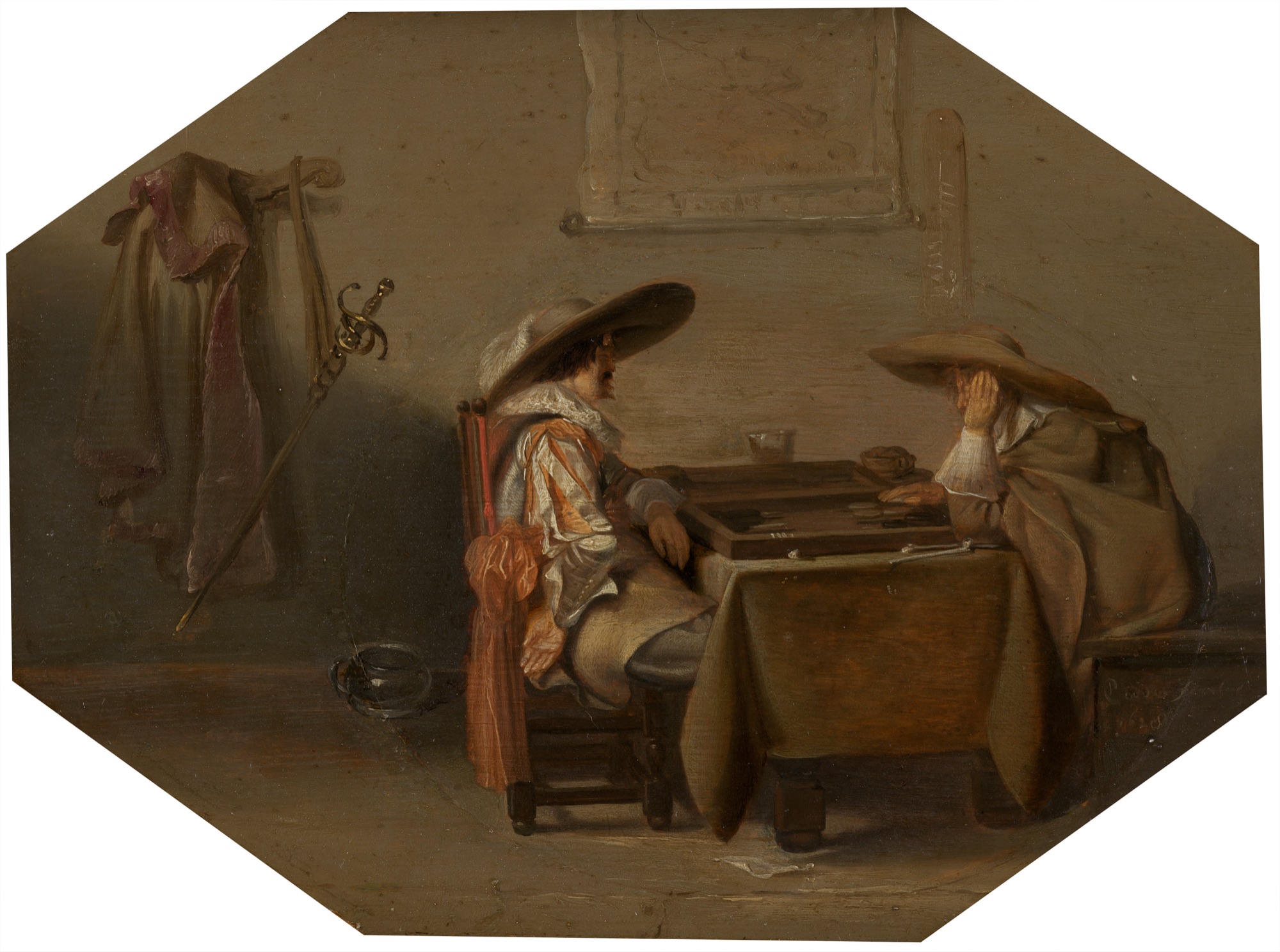
The English word arrives late. Backgammon is first found in print in 1647, in a letter of James Howell — probably from back and the Middle English gamen, a game, for the simple reason that hit checkers must go back and begin again. It named a sharper variant of the tables game the English had called Irish, and it won.
By 1743 Edmond Hoyle had set down its rules and odds in A Short Treatise on the Game of Back-Gammon — and “according to Hoyle” has meant playing properly ever since.
New York
The die that is never rolled
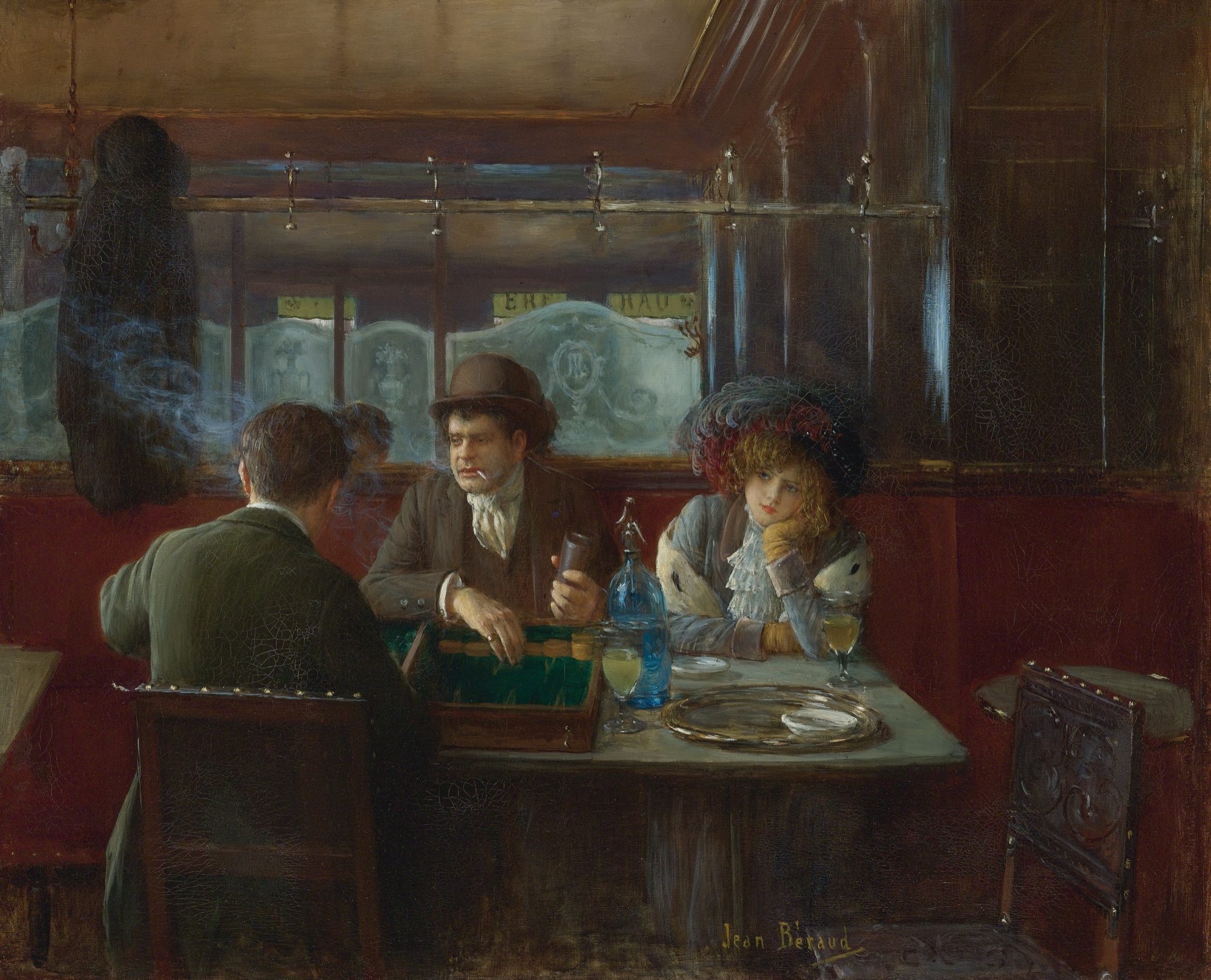
The modern game was finished not in a palace but in the clubs of Manhattan. Somewhere around 1925, a player whose name is lost proposed that the stakes might be doubled mid-game — and that the other side could accept, or concede on the spot. The practice was described in print by 1928; by May 1930 a Chicago department store was advertising the object itself, a cube faced 2, 4, 8, 16, 32, 64; by 1931 a committee at New York’s Racquet and Tennis Club had standardised the laws.
The doubling cube did to backgammon what nothing had managed in two thousand years: it made the race a game of nerve.
The Jet Set
Summer picks up the dice
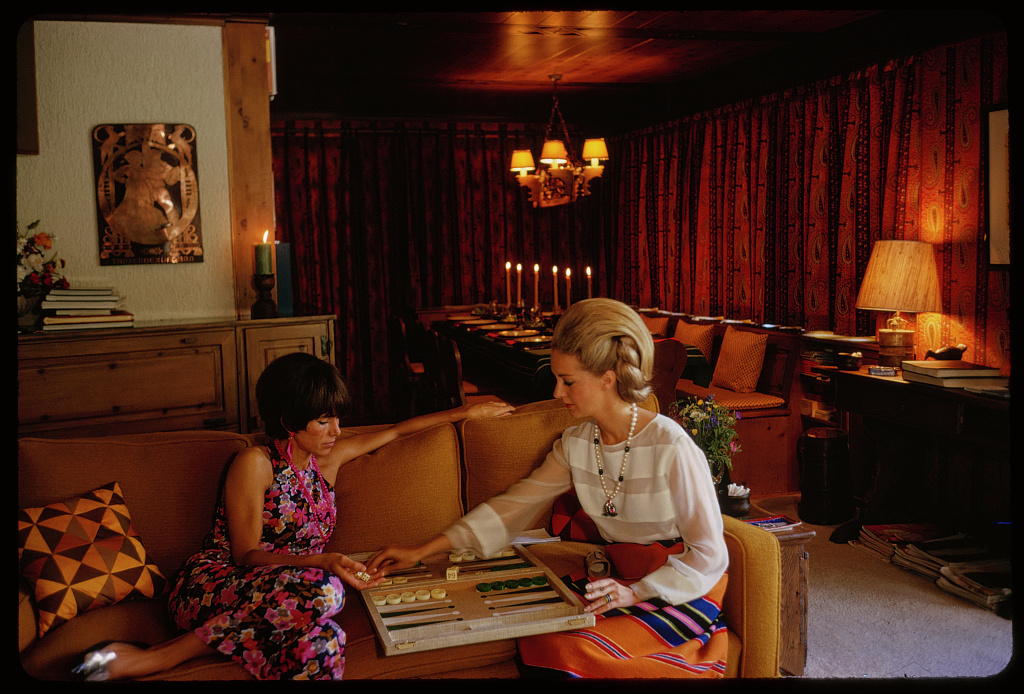
The revival has a name attached: Prince Alexis Obolensky, a Russian émigré of Palm Beach and New York, who organised the first international tournament in March 1964 at the Lucayan Beach Hotel in the Bahamas — some forty-eight players and a silver cup. By 1967 there was a World Championship in Las Vegas. By the seventies the game was simply where the beautiful people were: Hugh Hefner opened PIPS on Rodeo Drive, Lucille Ball lent her name to its annual tournament, Dunhill ran one aboard the QE2, and James Bond — obviously — played it with loaded dice in Octopussy.
Vogue sent Toni Frissell to photograph the game in a Swiss chalet. Slim Aarons kept finding it beside the pools he photographed. It has never really left either place.
Monaco
The last week of July
Since 1979 the World Championship has been played in Monte Carlo, in the last week of July — created when the London promoter Lewis Deyong merged the Bahamas world title with the European championship and brought both to the principality. Three hundred and forty players entered that first summer. The Italian Luigi Villa won it — and, in a very 1979 detail, lost 7–1 the next day to a computer, the first machine ever to beat a reigning world champion at any board game.
The tournament has run every summer since, except 2020, long at home in the Salon d’Or of the Fairmont — the hotel that sits over the hairpin of the Grand Prix circuit. The fifty-seventh edition opens on 27 July 2026. At the boards the play is famously dressed-down and deadly serious; the glamour is the principality, the calcutta auctions, and the night games that run long after the ballroom closes.
Everywhere
One game, many tongues
No game travels lighter. In Istanbul it is tavla, the standing furniture of the kıraathane coffeehouse; in the Arab world, tawla — “table,” straight from the Latin; in Iran, takhteh; in Greece, tavli, played as a trio — portes, plakoto, fevga — one after the other, all evening. Shesh besh spans three languages in two words: shesh, six in Persian and Hebrew alike; beş, Turkish for five. American sailors have played their own variant, acey-deucey, since at least the First World War.
And when Baghdad’s most famous literary café wanted to protect its conversation, in 1963, it did the only thing that would work — it banned the board. The game of the unhurried, everywhere the afternoon is taken seriously.
The Rules
How the game is played
Backgammon asks an evening to learn and gives back a lifetime. The rules below are complete — from the empty board to the doubling cube.
I
The board
Backgammon is played on a board of twenty-four narrow triangles — the points — divided by a raised spine, the bar, into four quadrants of six. Each player has a home board and an outer board. The points are numbered from each player’s own perspective: your one-point sits in your home board, your twenty-four-point deep in your opponent’s.
II
The opening arrangement
Each player begins with fifteen checkers: two on the twenty-four-point, five on the thirteen-point, three on the eight-point and five on the six-point. The arrangement is a mirror — both players face the same position, each from their own side of the board.
III
The object, and the direction of travel
The object is simple: bring all fifteen of your checkers around the board and into your home board, then remove them — bearing off. The first player to bear off all fifteen wins. Everything else in backgammon is the argument over how.
Checkers travel in one direction only — from your opponent’s home board, through the two outer boards, into your own — the two colours moving in opposite rotation, passing through each other on the way.
IV
The dice, and how checkers move
To begin, each player rolls one die; the higher number plays first, using both dice as rolled. Thereafter the players alternate, rolling two dice together.
The dice are read separately. A roll of five and three lets you move one checker five points and another three — or a single checker eight, in two steps, provided each step lands on an open point. A point is open when your opponent holds it with no more than one checker. Doubles are played twice over: double fours are four moves of four.
You must play both numbers if it is legally possible; if only one can be played, you play the higher. Only when no move exists at all does the turn pass.
V
Blots, hitting, and the bar
A checker sitting alone on a point is a blot. If an opposing checker lands on it, the blot is hit and set upon the bar. A player with a checker on the bar may do nothing else until it has re-entered — in the opponent’s home board, on a point shown by one of the dice and not held by two or more enemy checkers. Against a strong home board this can take some time. That is the game’s cruelty, and most of its charm.
VI
Bearing off
Once all fifteen of your checkers stand within your home board, the bear-off begins: a roll of five removes a checker from the five-point, a three from the three-point. A number higher than your highest occupied point removes a checker from that highest point. If you are hit during the bear-off, the checker returns the full length of the board and must come home again before you may continue.
VII
The doubling cube
The die that is never rolled. The cube carries the numbers 2, 4, 8, 16, 32 and 64. Before rolling, a player who likes their position may offer it: the stakes double, and the opponent either accepts — taking custody of the cube, and with it the sole right to double next — or declines, conceding the game at the current stake.
The cube is the game’s newest rule and its sharpest — it appeared in the New York clubs of the mid-1920s, and nobody knows who thought of it first. It turned backgammon from a race into a game of nerve.
VIII
Gammons and backgammons
Win before your opponent has borne off a single checker, and the game is a gammon — worth double. Win while they still have a checker upon the bar or in your home board, and it is a backgammon — worth triple. Multiplied, of course, by whatever the cube says.
A game this old asks only for a board that can keep up.
Giumoèl makes a magnetic backgammon set — the pieces stay where they are placed, on a deck, at altitude, on sand.